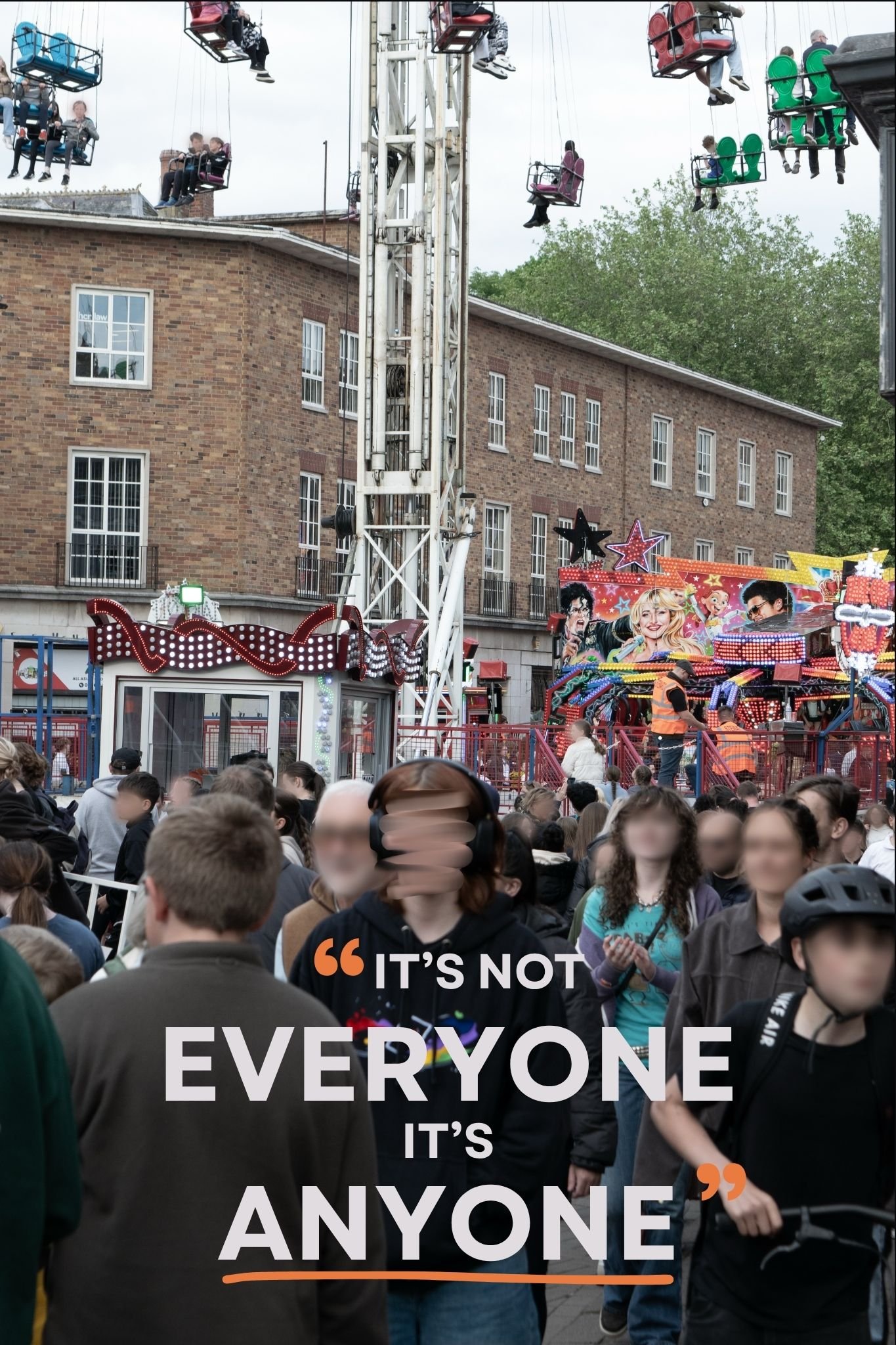
How safe do young people feel in Hereford city?
A youth-led consultation, supported by P.O.V., has been looking into what safety really looks and feels like for 14-18-year-olds growing up in Hereford today. The rural city has low crime statistics compared to urban centres, but what we heard from young people revealed that safety is not only about reported crime stats, but about perception, confidence, and freedom.
Feeling unsafe has become normalised for many young people. Participants told us they routinely change their behaviours to reduce risk. Many don’t feel safe in public places, especially after dark. Some LGBTQ+ young people said they “act less gay” to avoid harassment, while girls and young women described changing what they wear or when they travel.
Download the full youth-led Safety in Hereford 2026 report here.
Keep scrolling to hear more from young people involved, and see the creative responses from P.O.V.s Producers group.
BUTTON HERE.


Executive summary
This report presents the findings of a youth-led consultation exploring how safe young people aged 14-18 + feel when moving around the city of Hereford. Produced by Rural Media’s Point of View (P.O.V.) project, it has been designed to ensure that young people — particularly those whose voices are often underrepresented — could directly influence local decision-making, policy, and community action. Through anonymous surveys, focus groups, testimonies, and discussions, a clear message emerged: Many young people in Hereford do not consistently feel safe in public spaces, particularly after dark. While experiences vary, women and girls, LGBTQ+ young people, and other marginalised groups told us they feel disproportionately vulnerable to harassment, intimidation, abuse, and violence.
Feeling unsafe has become normalised for many young people. Participants described routinely changing their behaviour to reduce risk — avoiding certain routes, sharing live locations, pretending to be on their phone, travelling only in groups, altering their appearance, or suppressing aspects of their identity. Some LGBTQ+ young people said they “act less gay” to avoid harassment, while many girls and young women described modifying where they go, what they wear, or when they travel.
The report highlights that safety is not only about crime statistics, but about perception, confidence, and freedom. Young people repeatedly described wanting to feel able to move around Hereford without fear, hypervigilance, or the need to constantly assess danger. For many, the absence of safe public spaces, poor lighting, limited visible support, and low confidence in reporting systems contribute to ongoing anxiety and isolation. At the same time, the consultation also identified practical and achievable solutions.
Young people consistently called for:
Better street lighting and environmental design;
Increased visible and approachable policing;
More safe social spaces and youth provision;
Improved reporting mechanisms and victim support;
Better education around harassment, consent, and personal safety;
Stronger community responses to misogyny, racism, homophobia, and transphobia.
Ultimately, this work demonstrates the importance of listening to young people not only as service users, but as experts in their own experiences. Creating a safer Hereford will require collaboration between councils, schools, police, businesses, community organisations, and young people themselves. The message throughout this report is clear: young people want to feel welcomed, listened to, protected, and able to participate fully in city life without fear.
Created by young people, for young people, this piece of work is both a reflection of current realities and a call for meaningful change. This project was initiated by Callum Dover, a P.O.V. Producer and member of the Hereford City Youth Council, who approached P.O.V. with a clear ambition to better understand how safe young people feel in the city. Driven by his commitment to ensuring young people’s experiences are listened to and acted upon, Callum has led this piece of work; shaping, developing, and delivering this consultation and report, supported by P.O.V. and with creative responses made by the P.O.V. Producers.
Download the full report for more, including recommendations:
Written by Toni Cook, P.O.V. Creative Producer and Callum Dover, P.O.V Producer